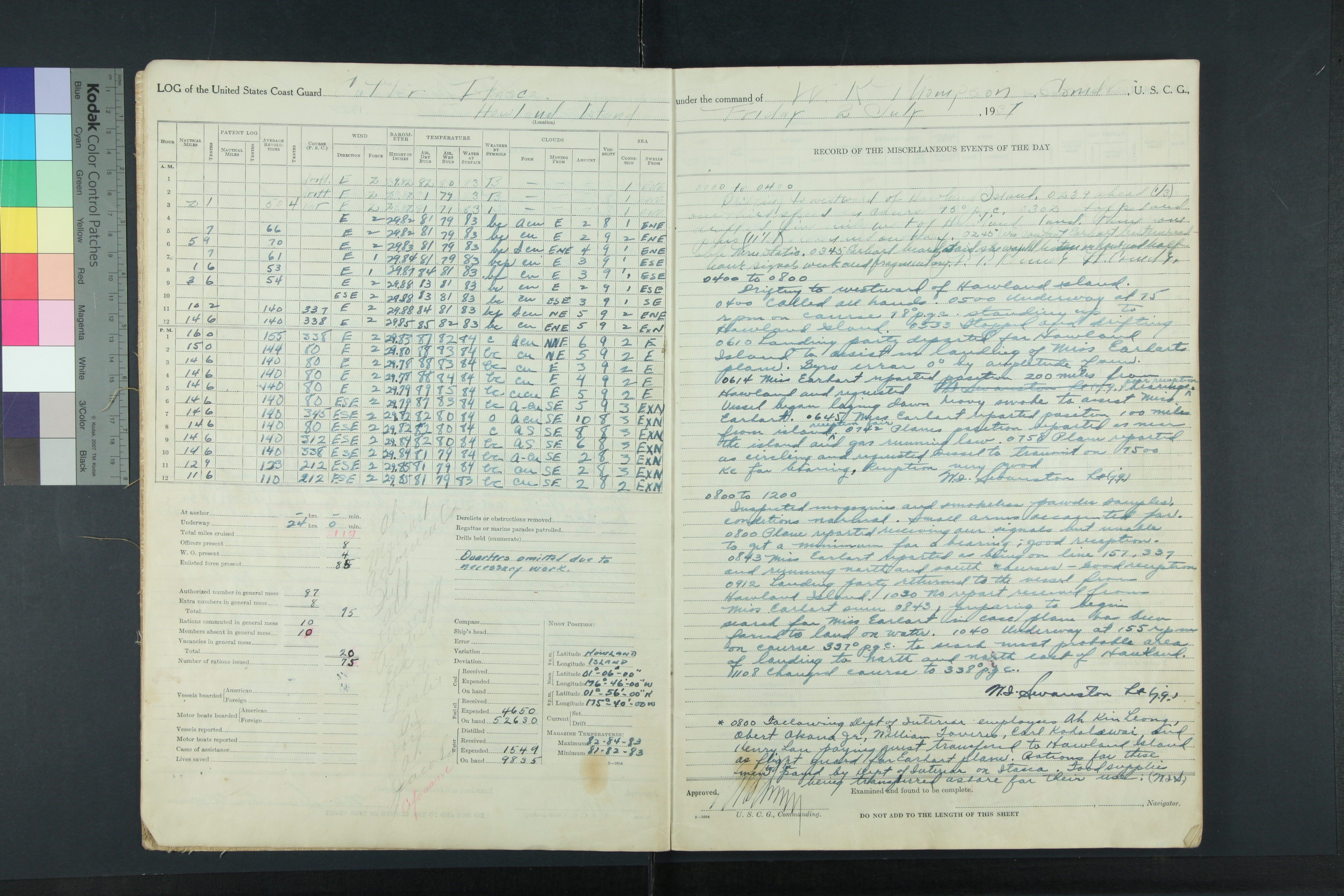
Any plausible theory about where Amelia Earhart and Fred Noonan’s final flight ended has to account for what is recorded in the radio room logs of the U.S. Coast Guard Cutter Itasca. Itasca was stationed just offshore of Howland Island, the flight’s destination, in support of the flight. One of the tasks of Itasca’s radio room personnel was to listen for voice radio messages Amelia would be transmitting on the frequency of 3105 kilocycles. When Amelia was first definitively heard in the Itasca radio room at 2:45 AM ship’s time, few if any of her words could be made out over the sound of static [1]. As she flew her Lockheed Model 10 Electra closer to Howland Island, the reception quality of her radio messages improved. Radio operators of the day rated the radio signals they heard on a progressive signal strength scale ranging from an S-1:"Hardly perceptible" to S-5: "Very good, perfectly readable" [2]. An Itasca radio room log provides signal strength ratings for three of the last four times Amelia’s messages were received, and in all three cases these were S-5 receptions. The strength of Amelia’s final few messages suggests the Electra was close to Howland Island at this time. Itasca’s chief radio man, Leo Bellarts, recalled in an interview that Amelia was coming in so strongly he went out onto the Itasca’s deck expecting to hear the Electra’s engines and see the plane fly over [3]. Amelia and Fred also believed they were close to Howland at this time. An Itasca radio log entry for the first of Amelia’s three S-5 messages, received at 7:42 AM ship’s time [4], records Amelia’s (radio call sign KHAQQ) message as:
KHAQQ CLNG ITASCA WE MUST BE ON YOU BUT CANNOT SEE U BUT GAS IS RUNNING LOW BEEN UNABLE TO REACH YOU BY RADIO WE ARE FLYING AT 1000 FEET
While Itasca was hearing Amelia quite well, this log entry tells us Amelia hadn’t heard any of Itasca’s attempts to contact her on the same frequency. For reasons that aren’t clear, two-way voice communication between the Electra and Itasca on 3105 kilocycles was never established before Itasca stopped hearing from Amelia. The only radio signals from Itasca that Amelia acknowledged hearing were strings of Morse code ‘A’s that Itasca transmitted on 7500 kilocycles as a homing signal. Itasca radio log entry for 8:00 AM ship’s time reports Amelia saying she had heard Itasca’s ‘A’s but was unable to take a bearing on them with the radio direction finding (RDF) equipment on board the Electra [5]. Amelia had arranged prior to the flight for Itasca to transmit the homing signal on 7500 kilocycles, apparently unaware that her RDF equipment was incapable of taking bearings on signals sent on frequencies higher than 1500 kilocycles. I think this error more than any other sealed Amelia and Fred’s fate. Had Amelia been able to take bearings on the Itasca’s ‘A’s from 8:00 AM onward she would have had at least 40 minutes to home in on Howland Island, enough time to cover roughly 80 miles if the Electra’s groundspeed was about 120 mph, a reasonable estimate. Amelia’s 8:00 AM message was the next-to-last time she was heard in the Itasca radio room. The last time she was heard was at 8:43 AM ship’s time, another S-5 reception. The Itasca radio log entry for this reception reads:
KHAQQ TO ITASCA WE ARE ON THE LINE 157 337 WL RPT MSG WE WL RPT N ES S THIS ON 6210 KCS WAIT
Translated from radio room shorthand, Amelia is saying that she was flying north and south on a 157-337 degree (magnetic) course line, the final course line Fred Noonan’s celestial navigation would have provided, and that she would repeat her message on 6210 kilocycles, the only other frequency on which her radio equipment allowed her to transmit. It would seem that Amelia and Fred were flying back and forth on the 157-337 line trying to spot Howland Island. Amelia may have wanted to repeat her message on 6210 kilocycles hoping that switching transmission frequency would resolve the communication problem with Itasca. Itasca listened for Amelia on 6210 and 3105 kilocycles but never heard her again.
%%%%%%%%%%%%%%%%%%%%%%%%%%%%%%
The Itasca radio room logs present a problem for the Nikumaroro Hypothesis. If the Electra was flying close to Howland Island from about 7:42 AM to 8:43 AM and its fuel supply was running low by 7:42 AM, it’s hard to believe that Amelia and Fred Noonan ended up at Nikumaroro, located some 400 miles (~350 nautical miles) southeast of Howland Island. A short article titled ‘3105 Donut’ in a 2008 issue of TIGHAR’s in-house publication TIGHAR Tracks [6] attempts to address this problem, or at least make it less of a problem for the Nikumaroro Hypothesis.
Recent software advances have made it possible to computer model the propagation properties of the Electra’s transmitting antenna to an unprecedented degree of accuracy.
As a result, the long-held assumption that the closer the plane was to Howland Island the stronger the signal heard by the Coast Guard would be, has been shown to be incorrect. A peculiarity in the antenna’s transmission pattern meant that if the plane was closer than about 80 nautical miles there was less than a 10% chance that Itasca would hear Earhart on 3105 kilocycles at maximum strength as recorded in the cutter’s radio log. Chances are the Electra was at least 80 and perhaps as much as 210 nautical miles from the ship at the time of the last transmission.
At 08:43-55 local time Itasca heard Earhart say, “We are on the line 157 337. Will repeat message. We will repeat this on 6210 kcs. Wait. We are running on line north and south.” The message came in at maximum strength. Given a newly discovered anomaly in the propagation pattern of the aircraft’s transmitting antenna, to have even a 10% chance of being heard at maximum strength, the Electra had to be somewhere within the “donut” shown. If on the line southeast of Howland, the plane was much closer to Gardner Island (Nikumaroro) than previously assumed.

TIGHAR’s 3105 Donut result put the Electra as close as ~160 miles (~140 nautical miles) to Nikumaroro when Amelia was last heard by Itasca at 8:43 AM. Amelia and Fred would still have to have decided to give up searching their immediate vicinity for Howland Island, which they thought they were close to, and flown steadily to the southeast for an hour or more to get to Nikumaroro. That still seems pretty implausible, but if you want to believe in the Nikumaroro Hypothesis, I guess you’ll take whatever reduction in implausibility you can get.
A reasonable question to ask about the 3105 Donut result is whether it is correct. TIGHAR never released a report explaining the nuts and bolts of the software modeling work underlying the result, but in 2011 a member of the group’s online forum started a thread to discuss the 3105 Donut result [7]. The TIGHAR member who did this work, a guy named Bob, responded to questions and comments posted there and in so doing provided insight into his work. A lot of what is discussed in this thread goes over my head, but I think I’ve managed to grasp a few key points. In response to one question Bob explains:
“The “donut” was computed by the ICEPAC propagation model, using the dorsal antenna gain pattern computed by 4NEC2. The SNR at the Itasca was computed versus Electra distance in 20-mile increments along the LOP, from 20 miles to 340 miles.”
Further along Bob explains:
“It’s possible that there was direct path propagation at short distances, due to excitation of the airframe, but ICEPAC only calculates path loss for an ionospheric path. However, at 1,000 feet altitude (where Earhart said she was flying then), the horizon distance is about 38 miles. So outside about 40 miles, there wouldn’t be any direct path, and skywave would govern.”
So there were two key parts to Bob’s modeling work: modelling the radiation pattern of the Electra’s transmission antenna using 4NEC2 software [8]; and calculating the signal-to-noise ratio (SNR) of Amelia’s radio messages as a function of distance using ICEPAC skywave propagation modelling software [9]. In the case of skywave propagation, radio signals from a transmitter are refracted back from the ionosphere towards the earth’s surface as they move away from their source; ‘skip zones’ can occur where the signals produced can’t be heard or are weakly heard, as illustrated in the figure below. According to Bob’s skywave propagation modelling work, the Electra was most likely between 80 miles and 210 nautical miles from Itasca when Amelia was heard at S-5 signal strength; at distances less than 80 miles his modelling work gave little chance of Itasca hearing her at S-5 signal strength.

Skywave and groundwave propagation [10]
There are two other ways Amelia’s messages could have reached Itasca: by line-of-sight transmission and by groundwave propagation. Bob’s TIGHAR forum posts explain why he ruled out these two possibilities. As the name suggests, line-of-sight transmission could only have occurred if the Electra was within visual range of Itasca, about 40 miles at the Electra’s last reported altitude of 1000 feet. Bob argues that the Electra was never in visual range of Howland Island because if it had been, Amelia and Fred would have seen Howland Island. I’m not convinced by this argument. According to the Itasca’s deck log [11], cumulus clouds covered 20 to 30 percent of the sky during the period when Amelia was heard at S-5 signal strength. What that cloud cover looked like can be seen in a photo of Itasca right offshore of Howland Island on the morning the Electra failed to arrive [12]. The Waitt Institute’s YouTube channel has a video shot from a helicopter flying at 1000 feet near Howland Island [13] that gives a sense of the difficulty of spotting the island under these conditions. If the Electra had gotten really close to Howland Island, maybe within five or six miles of it, the island would have been pretty hard to miss. But if they were twenty or more miles away? The Waitt Institute video tells me Howland would have been pretty difficult to spot at such distances. Whatever one might think about how easy it would have been for Amelia and Fred to spot Howland Island, it’s fair to say that Bob didn’t rule out the possibility of the Electra being within 40 miles of Howland based on radio wave propagation physics, he simply offered his own personal judgement about this possibility.
Groundwave propagation, like skywave propagation, allows radio signals to travel beyond the horizon at the source location. A key difference compared to skywave propagation is that in the case of groundwave propagation signal strength tends to steadily decrease with distance from the transmitter. The ‘donut hole’ result that came out of Bob’s ICEPAC skywave modelling isn’t something you’d expect to see for groundwave propagation of Amelia’s signals to Itasca. What led Bob to use the ICEPAC skywave propagation model rather than a groundwave propagation model? This is where his 4NEC2 software modeling of the Electra’s antenna radiation pattern comes into the picture. In the same TIGHAR discussion forum thread in which Bob made the comments I’ve excerpted from above, there is a series of exchanges between Bob and a forum member named Chuck about whether Bob had correctly modeled the radiation pattern produced by the Electra’s transmission antenna. At one point Chuck quotes something Bob had written in 2001 about the Electra’s transmitting antenna that explains why Bob chose a skywave propagation model [14]:
“In order for there to be a vertical electric field component, and hence a ground wave, it is necessary that the radiating antenna be vertical. If the antenna is horizontal, the electric field is parallel to the earth’s surface, and is immediately shorted out, causing the entire wave front to collapse, thus preventing ground wave propagation. And there’s the rub. The Electra’s antenna was horizontal, hence there was no groundwave.”
In 2001 Bob believed that the Electra’s transmitting antenna couldn’t radiate groundwaves because the net polarization of the radio waves it radiated at 3105 kilocycles was horizontal, thus Amelia was transmitting with what was effectively a horizontal antenna. The forum exchanges with Chuck indicate that this was still Bob’s opinion in 2018 when he obtained his ‘3105 Donut’ result. Chuck argued that the net polarization of the radiated electric field was vertical due to the contribution made by a vertical wire leading up to the ‘vee’ antenna on top of the Electra, so Amelia was transmitting with what was effectively a vertical antenna. Chuck had come to this conclusion based upon his own antenna modeling work, some of which is presented in the discussion thread. If Bob’s antenna modeling work was wrong, his 3105 Donut result wasn’t valid since there would then be no justification for using a skywave propagation model to determine how the signal strength of Amelia’s radio messages as heard by Itasca would have varied with distance.
I lack the expertise needed to adjudicate Bob and Chuck’s dispute, so this wasn’t something I thought I’d ever post about. But a while ago I came upon a YouTube video of a presentation that an expert in high frequency radio communications named Tom Vinson gave to the Brazos Valley Amateur Radio Club (BVARC) in 2020 [15]. This presentation rather convincingly shows that Bob’s 3105 Donut result is wrong.
The back story to Tom Vinson’s talk is that the ocean exploration company Nauticos [16], which has searched for the Electra on the sea floor near Howland Island, contacted experts at the Rockwell-Collins Corporation [17] asking whether it was possible to determine how far the Electra was from Howland Island based on the signal strength ratings of Amelia’s radio messages recorded in the Itasca radio logs. Tom was part of a team of Rockwell Collins personnel with extensive experience in radio communications that tackled this problem. The Rockwell Collins team took a comprehensive approach, investigating pretty much every factor that would have influenced the signal strength of Amelia’s messages as heard in the Itasca radio room. The figure below from Tom’s talk identifies the different aspects of the problem that were considered. In many cases, the research into some part of the Electra-Itasca radio link involved a combination of modeling and measurement work. Tom’s presentation describes the team’s work far better than I ever could, so I’ll simply refer readers to the video of his talk.
 |
| Courtesy of Tom Vinson |
The end result of the Rockwell Collins team’s work were Electra-Itasca distance estimates for signal strengths S1 through S5. The figure below from Tom’s talk presents these results as ‘range donuts’, minimum and maximum Electra-Itasca distances consistent with the five signal strength ratings. Tom mentions in his talk, and the figure’s text states, that the signal strength ranges overlap. I suppose this is because of uncertainties associated with the many factors influencing the signal strength versus distance relationship. Tom’s talk makes clear that the Rockwell Collins team modeled Amelia’s signals reaching Itasca by groundwave rather than by skywave propagation. My guess is that the S-5 range in the figure would have been depicted as a disk rather than a donut had it been meant to display the results quantitatively; I’m pretty sure signal strength wouldn’t have dropped off to less than S-1 at close-in to Howland for groundwave propagation. Or perhaps the ‘hole’ for the S-5 range is meant to convey the idea that if they were close enough, Amelia and Fred would certainly have spotted Howland Island (note added after completing this post: Tom confirmed that the S-5 range was a disk, not a donut).
 |
| Courtesy of Tom Vinson |
The Rockwell Collins team validated their groundwave propagation model by comparing the model’s prediction of the SNR-versus-distance relationship against measurements of the same for an airplane transmitting at a frequency very close to Amelia’s 3105 kilocycles while flying over the sea at an altitude of 1,000 feet. The agreement between model and measurement was excellent, see the figure below. The purpose of these measurements was to validate the Rockwell Collins team’s groundwave model; the plotted data isn’t meant to represent how signal strength varied with distance for Electra to Itasca radio transmissions. But I think this plot does illustrate that for the case of radio signals propagating as groundwaves there would have been nothing like the signal strength ‘donut hole’ result that came out of Bob’s modeling effort.
 |
| Courtesy of Tom Vinson |
About 33 minutes into his talk, Tom Vinson says that at Amelia’s 3105 kilocycle transmitting frequency “the only thing radiating on that aircraft was the lead, that six-foot piece of wire. That vee on there is a capacitive top hat at that frequency…She was running 50 W power input to a six-foot piece of wire…They were hearing her overnight when it was skywave and then of course hearing her real loud when it became seawave in the morning in daylight”. Note that ‘seawave propagation’ is simply a term for groundwave propagation happening over the sea. What Tom says here sounds a lot like the point Chuck made in his TIGHAR forum exchanges with Bob, i.e., that Amelia was transmitting her messages on 3105 kilocycles with a vertical antenna.
The key result that came out of the Rockwell Collins team’s work was an estimate of how far the Electra could have been from Itasca when Amelia’s radio messages came in at S-5 signal strength. Due to a non-disclosure agreement with Nauticos, Tom wasn’t free to precisely state the result, but he did say the result put the Electra within 100 miles of Howland Island. I’m not sure if Tom meant 100 statute or nautical miles, but for the purposes of this discussion it doesn’t matter. What does matter is that the Rockwell-Collins result is pretty much the inverse of TIGHAR’s 3105 Donut result.
Given the comprehensive nature of the Rockwell-Collins team’s work and their expertise to carry it out, I have to believe the Rockwell Collins team got it right and TIGHAR’s guy Bob got it wrong. The flaw in the Bob’s 3105 Donut result apparently was a consequence of incorrectly modeling the radiation pattern of the Electra’s transmitting antenna, which led to the mistaken use of a skywave propagation model to determine how the signal to noise ratio of Amelia’s voice messages varied with distance.
Tom Vinson’s BVARC presentation covers the Rockwell Collins team’s research up to the end of 2019. He didn’t discuss work the Rockwell Collins team did in 2020, though he did play part of a Nauticos video that gives a brief overview of that work. What motivated the 2020 work was that in 2019 the Rockwell Collins team obtained a Western Electric Model 13C transmitter, the same transmitter model that Amelia had abord her Lockheed Electra. It is quite possibly the only surviving example of this piece of equipment, and it was the only piece of equipment whose performance characteristics the Rockwell Collins team hadn’t yet experimentally evaluated. The Rockwell Collins team refurbished the Western Electric 13C, which allowed them to experimentally replicate the entire Electra-to-Itasca communication link using the same radio equipment on board the Electra and Itasca when Amelia and Fred went missing. This was a more integrated evaluation of the signal strength-versus-distance relationship than the Rockwell Collins team’s previous work had permitted.
The Rockwell Collins team used a Beech 18, an airplane very similar to Lockheed Model 10 Electra, as a stand-in for Amelia’s Electra. The Beech 18 was equipped with the refurbished Western Electric model 13C transmitter and an antenna matching the configuration of the transmitting antenna on Amelia’s Electra. The stand-in for the Itasca was a boat called the Nellie Crockett. The Nellie Crockett’s mast was fitted with an antenna matching Itasca’s receiving antenna connected to a refurbished CGR-32 receiver, the same receiver model used in the Itasca’s radio room. The Beech 18 flew at an altitude of 1,000 feet over the Atlantic Ocean transmitting recordings of a woman reading Amelia’s words as recorded in the Itasca radio room logs. The simulated Amelia messages were transmitted from the Beech 18 at various distances from the Nellie Crockett. What was heard through the CGR-32 receiver onboard the Nellie Crockett was recorded, along with parameters such as the signal strength of the simulated Earhart radio transmissions and the distance of the Beech 18 relative to the Nellie Crockett. This is a very brief outline of the work done in 2020. In separate interview videos that can be found online [18,19], Tom Vinson and another key member of the Rockwell-Collins team, Rod Blocksome, discuss the 2020 work far better than I possibly can. In his interview video Rod Blocksome says that this work provided a tighter constraint on the Electra - Itasca distance range for the S-5 signal strength receptions. Neither Blocksome nor Vinson say what the refined distance estimate is, presumably because of non-disclosure agreements. So, we’re still left with the result Tom Vinson provided in his BVARC talk, that the Electra was 100 miles or less from Howland Island when she came in at signal strength 5 in the Itasca radio room.
 |
| A Beech 18 on display at the National Air & Space Museum [20] |
 |
| Amelia Earhart's Lockheed Model 10 Electra [21] |
The Rockwell-Collins result doesn’t rule out the Nikumaroro Hypothesis, but it makes it seem rather unlikely. As I’ve already said, Nikumaroro is about 400 miles (350 nautical miles) southeast of Howland, about a two-hour flight from the closest point consistent with the Rockwell Collins result. I see no reason why. with fuel running low, Amelia and Fred would have chosen to fly steadily southeast for two straight hours, headed for parts unknown, when they thought they were close to their destination, the only place with a runway to land on they could possibly reach. In the circumstances they found themselves in, continuing to search nearby for Howland Island was clearly their best hope for survival. Amelia’s final message about flying back and forth on the 157-337 course line suggests that this is exactly what she and Fred were doing. In her final 8:43 AM message, Amelia said she would repeat her message on 6210 kilocycles, but Itasca never heard such a message. A good explanation for that is that the Electra ran out of fuel shortly after Amelia sent her 8:43 AM message. Flying at an altitude of 1000 feet, the Electra would not have stayed in the air more than a minute or two once its engines stopped. Tom Vinson speculates that the word ‘wait’ in Amelia’s last radio message -- KHAQQ TO ITASCA WE ARE ON THE LINE 157 337 WL RPT MSG WE WL RPT N ES S THIS ON 6210 KCS WAIT -- marks the moment the Electra’s engines began to sputter, and that she was too busy trying to fly the plane to an intact landing at sea to repeat her message.
There is more to say about the matter of the Electra’s fuel supply. Amelia expected that by closely following engine power and flight altitude recommendations provided by the Electra’s manufacturer she would have a few hours of flying time left when she got close to Howland Island. Tom Vinson said in the Q&A session that followed his BVARC presentation that Nauticos had commissioned Caltech researchers to estimate fuel consumption for the flight. The Caltech researchers concluded that the Electra ran out of fuel shortly after Amelia was last heard at 8:43 AM; altitude and course deviations she made, probably to avoid bad flying weather, as well as higher-than-expected headwinds, ate up the anticipated fuel reserve. According to Tom, an earlier-than-planned climb to high altitude when the Electra was heavily laden with fuel was particularly costly in terms of fuel consumption. As far as I know, TIGHAR hasn’t come up with its own fuel consumption estimates, it simply assumes that Amelia had enough fuel to fly for a few more hours when last heard by Itasca at 8:43 AM.
TIGHAR hasn’t had much to say about the Rockwell-Collins group’s research results, which had been in the public sphere at least as early as 2020 when Tom Vinson’s BVARC talk appeared on YouTube. The only time I know of that TIGHAR discussed the Rockwell Collins team’s work was to comment on a 2025 Nauticos press release that reads:
CAPE PORPOISE, Maine, Aug. 19, 2025
Nauticos, a leader in deep-sea exploration and historical research, today announced plans to launch a fourth expedition aimed at locating Amelia Earhart's Lockheed Electra, driven by newly acquired proprietary data revealing the likely resting place of the aircraft. This cutting-edge research offers the most precise information yet about Earhart and navigator Fred Noonan's final position before their disappearance on July 2, 1937.
After extensive restoration and analysis of an identical radio system used by Earhart and Noonan, Nauticos has determined their approximate location at 8 a.m. on the day they vanished. This groundbreaking discovery significantly refines the search area near Howland Island, the intended destination of Earhart's ill-fated flight.
About a week after the Nauticos press release appeared, TIGHAR sent a mass email to its membership with the following commentary:
The press release is a bit misleading. The “newly acquired proprietary data” was acquired in September 2020 with a Twin Beech provided by Dynamic Aviation in Bridgewater, Virginia. N18G is now for sale. If you scroll to the bottom of the Dynamic Aviation sales ad there’s a video describing the test flight.
There are flaws in the Nauticos reconstruction that invalidate the data. To get accurate readings you have to duplicate not only the transmitter and the power, but also the precise antenna length (including lead-ins) and its surrounding electrical ground, i.e., the aircraft itself. In other words, the small Twin Beech doesn’t work. In 2019, TIGHAR Senior Researcher Bob Brandenburg computer-modeled Earhart’s radio signal propagation and discovered an anomaly. The long-held assumption that the closer the plane was to Howland Island the stronger the signal heard by the Coast Guard would be, was incorrect. If the plane was closer than 80 nautical miles there was less than a 10% chance that Itasca would hear Earhart on 3105 kilocycles at maximum strength as recorded in the cutter’s radio log. Chances are the Electra was at least 80 and perhaps as much as 210 nautical miles from the ship at the time of the last transmission. We passed that information to Nauticos at the time, but they ignored it.
I’m guessing this was written by TIGHAR Director Ric Gillespie. Gillespie claims the work done in 2020 is invalid because the Rockwell Collins team failed to reproduce Amelia’s Electra and its transmitter antenna closely enough. It’s not clear what, if anything, Gillespie actually knows about “antenna lengths (including lead ins)” as configured in the 2020 Rockwell Collins work. How large an error might have been introduced by using a Beech 18 as a stand-in for Electra or by not closely reproducing the Electra’s transmitting antenna geometry, if that is even true, Gillespie doesn’t say. He offers nothing in the way of modeling results or experimental measurement data to support his critique, and I doubt he has anything of the kind to offer. The person who did the 3105 Donut work, Bob, passed away several years ago and I suspect TIGHAR currently has no one capable of providing a technically informed critique on the Rockwell Collins team’s work. Ric Gillespie is claiming that a team of engineers with decades of experience in radio communications failed to see flaws Gillespie seems to have readily identified. I find that very hard to believe. Rod Blocksome mentions in his YouTube interview that the Rockwell Collins work was reviewed by a University of Maryland electrical engineering professor. This reviewer apparently failed to spot any significant flaws in the work. When I began reviewing material to write this post, I contacted Tom Vinson with questions about the research he discussed in the BVARC presentation. Coincidentally, while I was exchanging email messages with Tom, a TIGHAR member forwarded me a copy of the TIGHAR email. I asked Tom about the TIGHAR critique, and he stood by his team’s work. He also told me the team had made measurements to ensure the 2020 flight experiments were an appropriate simulation of the Electra - Itasca radio link on the morning Amelia and Fred went missing.
After dismissing the Rockwell Collins team’s research, the TIGHAR email goes on to repeat the original 2008 TIGHAR Tracks 3105 Donut Hole article nearly word for word, closing with “We passed that information to Nauticos at the time, but they ignored it”. This is a classic bit of TIGHAR self-aggrandizement -- we’re the experts, we tried to set Nauticos straight, but they didn’t listen. I suspect Nauticos simply decided it wasn’t worth the bother to set TIGHAR straight.
Unfortunately, for many TIGHAR followers pretty much everything they’ve been told about the Earhart disappearance has come from TIGHAR. But at TIGHAR ideas and evidence that run against the Nikumaroro Hypothesis are sometimes discounted if not outright ignored. That certainly was the case with the Nikumaroro sextant box and with ‘Artifact 2-2-V-1’ the piece of aluminum from a World War II era C-47 transport plane TIGHAR found on Nikumaroro, as discussed in my previous posts. The possibility that the castaway of Nikumaroro was a crewman from the Norwich City, the freighter that ran aground there in 1929, has been researched carefully by a former TIGHAR member [22]. That research effort was apparently conducted without any significant support or encouragement by TIGHAR. I don’t expect TIGHAR to willingly give the Rockwell Collins research its due, but I hope TIGHAR members reading this post will follow watch those Vinson and Blocksome videos at the links provided and consider the implications for the Nikumaroro Hypothesis. Perhaps some TIGHAR member who views those videos will post on the TIGHAR discussion forum there to make the Rockwell Collins research more widely known to TIGHAR membership.
Thank you to Tom Vinson, Kenton Spading, and Chuck for providing comments on a draft of this post. All errors are my responsibility, of course.
Comments, corrections, additional relevant facts, differing viewpoints, etc., are welcome. Send to gardnersghost@gmail.com
Footnotes
[1] Memorandum written by Richard Black, U.S. Department of the Interior, July 29, 1937. Black acted as liaison between Earhart and the various U.S. Government agencies supporting Amelia’s flight. He was at Howland Island on July 2, 1937. Black’s memo includes as an attachment a transcript of Itasca radio log entries obtained from Lieutenant Commander Baker, the Itasca’s Executive Officer. Earhart’s 2:45 AM message was largely unintelligible but two reporters listening in the Itasca radio room recognized Earhart’s voice. Itasca Chief Radio Man Leo Bellarts believed that he had heard Amelia say “cloudy and overcast”. https://documents3.theblackvault.com/documents/earhart/126_PI_154_1-O_Box14_9_12_21_Equatorial_Islands_Aviation_1936_1951.pdf
[2] The Radio Amateur’s Handbook. Newington, CT, page 364. American Radio Relay League. 1936. Available at: http://www.tubebooks.org/Books/arrl_1936.pdf
[3 Leo Bellarts’ comments were made in an interview conducted in 1973 by Earhart researcher and author Elgen Long. This part of what Bellarts said was incorporated into a mock interview that podcaster Chris Williamson constructed from excerpts of audio recordings of Long’s interview with Bellarts. Chris Williamson’s mock Bellarts interview can be accessed at: https://podcasts.apple.com/us/podcast/khaqq-calling-itasca-a-conversation-with-leo/id1645810327?i=1000579875388
[4] Separate logs were kept for two positions in the Itasca radio room. For the purpose of this blog post I refer to the radio room position #2 log typed in real time, i.e., the ‘raw log’. Digitized scans of this log can be found at: https://www.archives.gov/college-park/highlights/earhart-log
[5] Note that Amelia heard Itasca’s Morse code ‘A’s using her RDF loop antenna on top of the plane. The loop antenna was separate from the vee antenna Amelia was relying on to hear Itasca’s 3105 kilocycle voice messages.
[6] The 3105 Donut. In TIGHAR TRACKS, Volume 24, #4, October 2008, page 3. https://tighar.org/Publications/TTracks/2008Vol_24/1008.pdf
[7] TIGHAR Forum, 3105 Donut thread: https://tighar.org/smf/index.php?topic=285.0
[8] NEC Based Antenna Modeler and Optimizer. https://www.qsl.net/4nec2/
[9] General Information on the VOACAP Propagation Prediction Model. https://www.voacap.com/2023/itshfbc-help/icepac-general.html
[10] Introduction to Radio Equipment. U.S. Navy Training Courses, Edition of 1946. Chapter 21, page 22. U.S. Government Printing Office, Washington, D.C. (1946). Chapter 21 can be accessed at: https://maritime.org/doc/radio/index.php
[11] Itasca Deck Log: https://media.defense.gov/2022/Mar/14/2002955993/-1/-1/0/370702-G-CG969-1001.JPG
[12] The cloud cover photo appears about twenty seconds after the start of this video: https://vimeo.com/469779444 Notice that the Itasca was producing smoke as a potential visual aid to Earhart. Meteorological conditions were such that the smoke stayed near the sea surface, probably making it less useful as an aid to spotting Howland Island.
[13] POV: Howland Island. Waitt Institute YouTube channel: https://www.youtube.com/watch?v=m9c3yZ0xeHw
[14] https://tighar.org/smf/index.php?topic=285.msg5767#msg5767 Note that I’ve corrected an error in Bob’s word choice, as pointed out by Chuck in the discussion thread. Bob meant to write ‘electric field’, not ‘electrostatic field’. Bob acknowledges the error later in the thread.
[15] The Search for Amelia Earhart’s L-10E Electra: An HF Systems Engineering Approach. Tom Vinson, NY0V. Brazos Valley Amateur Radio Club (BVARC) YouTube channel: https://www.youtube.com/watch?v=bdA6bm9tL8M
[16] Nauticos LLC Website: https://nauticos.com/
[17] Rockwell Collins Wikipedia page. https://en.wikipedia.org/wiki/Rockwell_Collins
[18] Meet the Engineer on a 26 Year Journey to Find Amelia Earhart’s Plane. Amelia Rose Earhart YouTube channel: https://www.youtube.com/watch?v=pwYo1kq89xc
[19] Episode 1: How to Find Amelia Earhart with Nauticos Radio Engineer Rod Blocksome. Amelia Rose Earhart YouTube channel: https://www.youtube.com/watch?v=yN4A-ENyChU&t=28s
[20] Photo of Beechcraft D18S Twin Beech at the National Air and Space Museum. https://airandspace.si.edu/collection-objects/beechcraft-d18s-twin-beech/nasm_A19761792000
[21] Photo of Amelia’s Lockheed Model 10E Electra in the San Diego Air & Space Museum collection. Catalog number 01-00091572. Viewable online at: https://www.thisdayinaviation.com/amelia-earharts-lockheed-electra-10e-special-nr16020/
[22] A Lost Sailor or Amelia Earhart? Lost Norwich City Crewman: Potential Sources of Human Remains Discovered in Gardner Island (Now Nikumaroro Island) in 1940. This paper can be downloaded at Academia.edu. https://kentonspading.academia.edu/research#papers