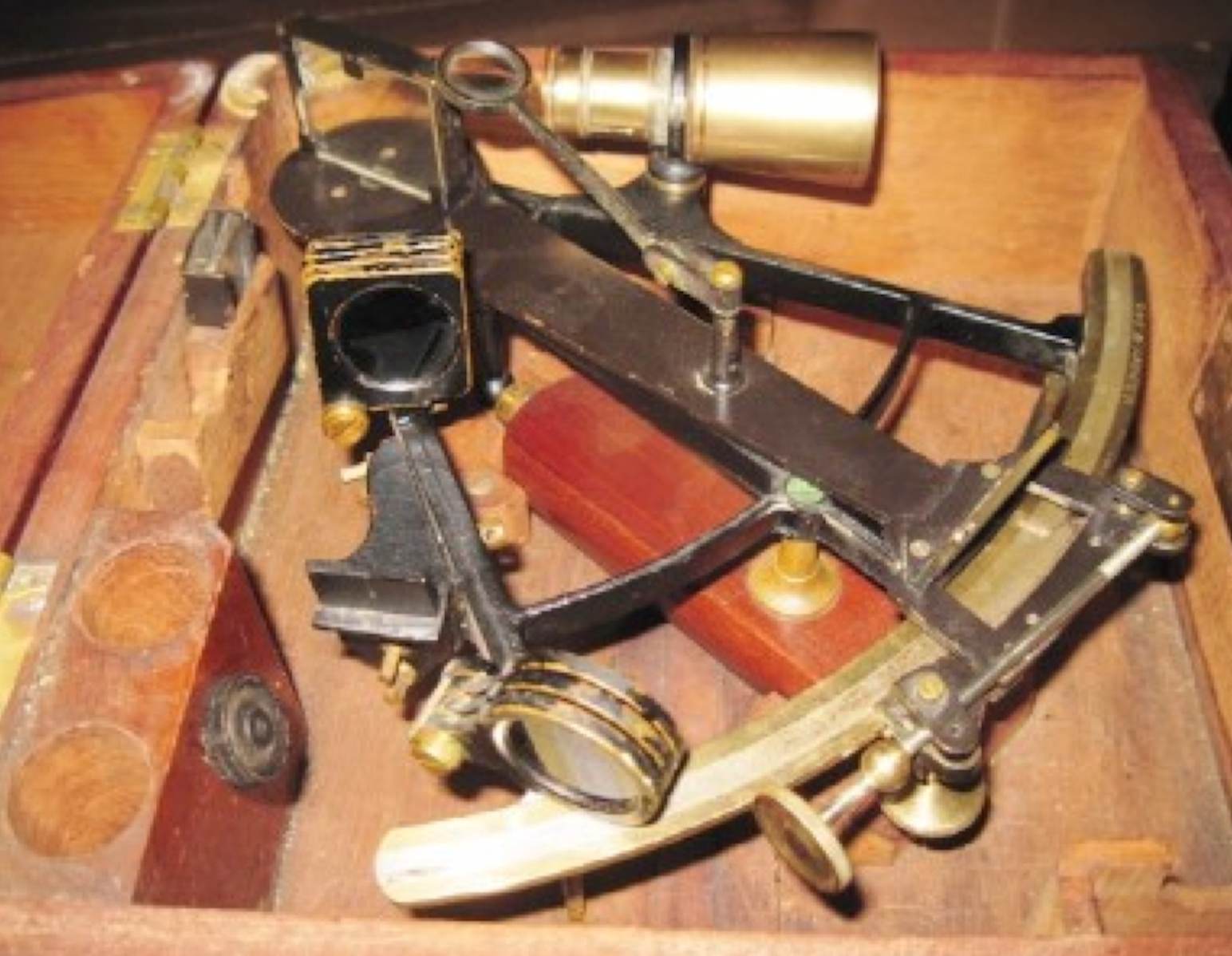
Friday, December 15, 2017

Brandis Sextant Taxonomy, Part Six: U.S. Navy Sextant Specifications


Brandis Catalog No. 20, which I’ve referred to in several earlier posts, tells us about a few key features of four different Brandis sextant types.  A great deal more information about three of these sextant types can be found in the sextant specifications that were published from time to time by the U. S. Navy.  The Navy began publishing specifications for sextants in the 1890s with the aim of improving the quality of the sextants produced for it by instrument manufacturers.  As explained in the Department of Nautical Instruments section of the U. S. Naval Observatory’s Annual Report for fiscal year 1895 [1]:

The province of this department is to receive, inspect, and issue to the vessels of the Navy all instruments (chronometers and watches excepted) furnished for navigating and surveying purposes.
In order to put this important service upon a proper basis and to assure its systematic working whereby the best instruments can be obtained, detailed specifications have been prepared with great care for sextants, high-grade and surveying; octants; binocular glasses, day and night; quartermaster’s spyglasses, high, medium, and low power; officer-of-the-deck spyglasses; barometers, mercurial and aneroid; clocks, deck and boat; three-arm protractors, and theodolites.


A complete outfit of the apparatus necessary to the thorough inspection of instruments has been provided for and will soon be installed for use. Contractors have experienced some difficulties in fulfilling the requirements of the specifications, but better progress in that direction is now being made, and by rigidly enforcing the specifications our ships are being supplied with instruments of the above classes uniform in pattern and excellent in quality.


I have copies of the U.S. Navy’s surveying sextant specifications published in 1897 and 1901, its high grade sextant specifications published in 1897, and its specifications for octants published in 1900 [2].  Each of these documents is four pages long and consists of a series of numbered sections stipulating the features of a particular sextant component or accessory.  The sextant features described in Brandis Catalog No. 20 match up well with those put forth in the specifications, even though Brandis Catalog No. 20 was published about 15 years after these specifications appeared [3].  For example, the catalog listing for the “U.S. Navy Surveying Sextant” states that it has a 6-inch radius and reads to 30 seconds of arc, while the 1901 surveying sextant specifications requires a frame radius not less than 5.75 inches nor more than 6.0 inches and a vernier scale providing a reading precision of 30 seconds of arc; the catalog listing for the ‘U.S. Navy High Grade Sextant’ states that it has a 7-inch radius and is readable to 10 seconds of arc, while the 1897 high grade sextant specifications require a frame radius between 7 and 7.5 inches and a vernier scale providing a 10 second reading precision; the catalog listing for the ‘U.S. Navy Octant’ states that it has a 7-inch radius and is readable to 30 seconds of arc, while the 1900 octant specifications require a frame radius between 7 and 7.5 inches and a vernier scale providing a 30-second reading precision.

Something I find curious about the Navy surveying sextant specifications is that they require surveying sextant frames to have four radial arms “stiffened by one transverse brace, which shall be an arc of a circle concentric with the limb”.  The ‘U.S. Navy Surveying Sextant’ illustrated in Brandis Catalogue No. 20 (see illustration below) has the required curved transverse stiffener brace, but it also has a second, straight, transverse stiffener brace, and I’ve seen many Brandis surveying sextants made for the Navy that have this frame pattern.  I’ve also seen surveying sextants made for the U.S. Navy by two other U.S. manufacturers, Keuffel & Esser, and Buff & Buff, that have two transverse braces, although these surveying sextants have two curved transverse stiffener braces [4].  It seems that these three sextant manufacturers believed that two transverse braces were needed to give their Navy surveying sextant frames sufficient stiffness, so then why is it that the Navy surveying sextant specifications required only one transverse brace?


There are only a few differences between the surveying sextant specifications published in 1901 and those published in 1897.  One such difference is in the specification for the tangent screw used to make fine positional adjustments to the sextant’s index arm.  The 1897 specifications call for a single-headed, 4.1-inch long, tangent screw, while the 1901 specifications call for a two-headed, 2.75-inch long, tangent screw.  This arcane difference is of interest to me because I’ve collected photos of dozens of Brandis sextants that I’ve found on eBay and other web sites, and many of these photos provide a good view of the sextant’s tangent screw.  When I went through my photo collection I was able to clearly identify twenty-two of them to be surveying sextants [5].  Of these twenty-two surveying sextants, only the oldest of them, Brandis serial number 1899 [6], has a long, single-headed, tangent screw.  The rest of them, spanning a range of Brandis serial numbers from 2539 to 5675, have a short, two-headed tangent screw (see table and photos below).


Brandis Surveying Sextant Serial Numbers and Tangent Screw Types


Brandis #1899

Brandis #2539
Brandis #5675

If it is assumed that Brandis manufactured these sextants to U.S. Navy specifications [7], then Brandis #1899 must have been made no later than 1901, the year that surveying sextant specifications calling for the shorter tangent screw was published [8].  The ‘no later than’ date for the manufacture of Brandis #1899 provides an additional reference point for the Brandis serial number chronology that was presented in ‘What do the Numbers 3500 and 1542 Tell Us? Part Two’.  Some time in the not-too-distant future I will post a revised version of the Brandis serial number chronology that will include the reference point provided by Brandis #1899 as well some others I’ve arrived at since that chronology appeared.

If there is a master list of all U.S. Navy sextant specifications ever published, I have not seen it, but I do know that the four specifications I have copies of aren’t the only ones ever published.  According to the National Directory of Commodity Specifications [9], the Navy published surveying sextant specifications in 1912 and high grade sextant specifications in 1914.  An article in the July 24, 1918 issue of the trade journal  Jeweler’s Circular Weekly, which is reproduced in the post titled ‘What do the Numbers 3500 and 1542 Tell Us? Part Three’ reports the recent publication of Navy surveying sextant specifications and states that these new specifications supersede those published in 1912.  I know that octant specifications were published in 1895, because my copy of the 1900 octant specifications ends with the statement “Reprint of May 20, 1895. No change”.  I have not found any indication of the existence of specifications for either of the other two Brandis sextant types discussed in earlier posts, the astronomical sextant listed in Brandis Catalog No. 20, or the Brandis sextant with the 5-inch radius frame whose name I am uncertain of.

I would like to have copies of all the U.S. Navy sextant specifications ever published.  If I knew what changes the 1918 surveying sextant specifications called for relative to 1912 specifications, I might be able to find where in my collection of Brandis sextant photos those changes first appear and so add another dating reference point to the Brandis serial number chronology.  If the Navy published specifications for the 5-inch sextant type whose name I am uncertain of, I’d have a definitive name for this sextant type.  There are some specific changes I’d expect to see in versions of the sextant specifications that published after the ones I have copies of.  For instance, each of the four sextant specifications I have copies of require that sextants be supplied to the Navy in sextant boxes having a brass plate sunk into the top of their lids.  The purpose of this plate is made clear in the octant specifications, which states that the manufacturer was to mark the plate with the sextant’s Naval Observatory number, the Naval Observatory hallmark (the letter ’N’ inscribed with the letter ‘O’), and the words ‘U.S. Navy’ upon acceptance of the sextant by the Navy.  I’ve seen these plates in the lids of Brandis sextant boxes made before World War One (see photo below), but not in the lids of Brandis sextant boxes made during World War One and so I suspect that the specifications in effect during the war no longer required them; it would be nice to to read those specifications to see if this is in fact true.

Box Plaque for Brandis 2763/USNO 348, an Octant

I’ve looked at sextants made by two of Brandis’ U.S. competitors to see how well they match up with the Navy specifications, but I’m not sure I can quickly summarize what I found so I’ll save that discussion for another post.  I’ll end this post by repeating something I may have mentioned in an earlier post, and that is that I’ve seen a few Brandis sextants that don’t match any of the sextant types listed in Brandis Catalog No. 20.  Some of these sextants have features that don’t jibe with the specifications that I have copies of.  This too is something that requires more than a brief discussion, and so I will save it for a future  post.
___________________
UPDATE (12/17/2017):
Having written only two days ago that Brandis #1899 is the only surveying sextant I’ve seen that has a long, single-headed tangent screw, this morning I came upon a second Brandis surveying sextant, Brandis #1839, with this type of tangent screw. The Brandis serial number and ‘U.S. Navy’ is stamped into the arc, as per a few other old Brandis sextants, and the front of the box is marked ‘Sur Sex 1839’.  A scrap of a Naval Observatory certificate remains, enough to see first two digits of the Brandis serial number and the letters ‘Su’ on the line for sextant type.  See photos and updated table below.


Comments, corrections, additional relevant facts, differing viewpoints, etc., are always welcome.  Send to gardnersghost@gmail.com
+~+~+
Footnotes
[1] Report of the Superintendent of the U.S. Naval Observatory for the Year Ending June 30, 1895.  Washington.  U.S. Government Printing Office, 1896. Page 116.
[2] These four sextant specifications were copied onto microfiche by the Congressional Information Service and are available at libraries around the United States. U.S. Executive Branch Documents, 1789-1909; numbers N-507a -241,-269,-270, and -271.
[3] See the post titled ‘A Brief Note on the Date of Publication of Brandis Catalogue No. 20’ published on February 16, 2017.
[4] The frame pattern of Keuffel & Esser and Buff & Buff surveying sextants, however, differs from Brandis surveying sextant in that both transverse braces are curved.  The K&E and B&B sextants I refer to here have Naval Observatory inspection certificates identifying them as surveying sextants.
[5] I determined each sextant to be surveying sextant if it’s frame had one straight and one curved stiffening brace and at least on of the following was true: there was a Naval Observatory inspection certificate for the sextant identifying it to be a surveying sextant, or the sextant’s arc scale was divided in 20 minute intervals.  Both cases were often true. 
[6] Brandis #1899 is not marked with  U.S. Naval Observatory serial number but we can be sure it was once in U. S. Navy service because ‘U.S. Navy’ is stamped into its limb, as can be seen in the photo of this sextant in this post. 
[7] Note that most of these sextants in Table 1 have a U.S. Naval Observatory serial number, indicating they were inspected to Navy specifications at the Naval Observatory.  Note also that Brandis Cat No. 20, which was aimed at the civilian market, calls its surveying sextant a ‘U.S. Navy Surveying Sextant’, which suggests to me that even the surveying sextant that Brandis sold to civilians were made to Navy specifications.
[8]  Most of the sextants in Table 1 were made during World War One, thus if Brandis manufactured them to U.S. Navy specifications, then the Navy surveying sextant specifications in effect during World War One must have required the short, two-headed tangent screw.
[9] National Directory of Commodity Specifications. National Bureau of Standards U.S. Government Printing Office, 1925. Page 289. This can be found online at Google Books.

Thursday, February 16, 2017

A Brief Note on the Date of Publication of Brandis Catalogue No. 20

I’ve previously noted that Brandis Catalogue No. 20, which is not dated, contains a testimonial letter from a customer dated December 12, 1914, and so we know the earliest that it could have been published was some time in 1915 [1].  Up until a couple of days ago my best guess for the latest date that it could have been published was sometime in 1917.  That ‘no later than’ date was based on the presence of the ‘Brandis & Sons Mfg. Co’ firm name on the catalog’s front page.  If the Brandis firm name was changed from ‘Brandis & Sons Mfg. Co’ to ‘Brandis & Sons, Inc.’ sometime in 1917 as I've previously suggested [1], then Brandis Catalogue No. 20 must have been published sometime between early 1915 and the end of 1917.
 
I can now shave about a year and a half from that ‘no later than’ date.  A few days ago I came across volume 181 of the Journal of the Franklin Institute [2], which lists Brandis Catalogue Number 20 as a gift to the Franklin Institute’s library.  Volume 181 covers the period from January to June of 1916, and so the date range for the publication of Brandis Catalogue No. 20 is narrowed down to sometime between early 1915 and June of 1916.

Although I can’t prove it, I suspect that Brandis Catalog No. 20 was published in the first half of 1916.  I think that in early 1916 Brandis was giving away copies of its newly-published Catalogue No. 20 to technically-oriented institutions around the country, and the Franklin Institute was a recipient of one of these free catalogs.  As support for this idea, I note that the John Crerar Library in Chicago, another technically-oriented institution, lists "Brandis & Sons Mfg. Co." as the donor of an unspecified ‘volume or pamphlet’ in its annual report for calendar year 1916 [3].

The date of publication of Brandis Catalog No. 20 is a fairly arcane matter, but I felt it was worth this brief note because this catalog tells us exactly what four types of Brandis sextant looked like at a particular period of time.  Pinning down just when that particular period of time was as well as we possibly can doesn’t seem like such a bad idea.

Comments, corrections, additional relevant facts, differing viewpoints, etc., are always welcome (no one will be banned, blocked, or castigated for offering differing opinions).  Send to gardnersghost@gmail.com 
+~+~+~
References/Footnotes
[1] See footnote 1 of ‘A Brandis Sextant Taxonomy, Part Five - Five Inch Radius Sextants’.
[2] Journal of the Franklin Institute, Volume 181, No. 6, June 1916.  page 864.  This can be downloaded at Google Books.
[3] The John Crerar Library Twenty Second Annual Report for the Year 1916, page 34.  This can be downloaded at Google Books.

Monday, February 6, 2017

Brandis Sextant Taxonomy, Part Five - Five Inch Radius Sextants

Brandis 3249, which was the subject of the post titled ‘A Strange Beast’, is an example of a fifth type of sextant that Brandis and Sons was making in the early twentieth century.  It has a frame with a 5-inch radius, two radial arms, and a single curved stiffener brace.  Its arc scale is divided in 30 minute intervals and it can be read to a precision of 1 minute with the vernier scale on its index arm.  Unlike the four sextant types discussed in previous posts in this series, sextants like Brandis 3249 do not appear in Brandis Catalog No. 20 [1].

Brandis 3249
Brandis 3249 was the first example of a sextant of this size and frame pattern that I came across, but I’ve seen several more of them since then.  Some, like Brandis 3249, are equipped with a pinhole sight and shade glass selector wheel, while others, like Brandis 3692 and Brandis 3738, are equipped with a sighting tube or a telescope.  Brandis 3692 and Brandis 3738 are equipped with a set of index shades, which are standard components of the four types of Brandis sextants discussed in previous posts in this series, however they lack the set of horizon shades that are also standard components of these other four sextant types.  The sextant in the photograph below, reproduced from a Carnegie Institution report on early experiments in aerial navigation [2], has yet another configuration of optical components.  It has a pinhole sight like Brandis 3249, but rather than having a shade glass selector wheel, this sextant has the arrangement of shade glasses seen on Brandis 3738 and Brandis 3692, i.e., it has a set of index shades but no horizon shades. I have not seen a surviving example of a sextant with this particular configuration of optical components.

Brandis 3738
Brandis 3692


Carnegie Report Sextant

The caption of the photo in the Carnegie report states that this sextant is a “Patrol-boat-type sextant, with 5-inch arc”, and a section of the report titled ‘Report of November 13, 1918 on Progress Since October 1 in Developing Astronomical Methods for Determining Geographic Positions of Airplanes on Long Flights’ provides the following additional details:

“At the United States Naval Observatory a small patrol-boat-type sextant (see Pl. 14, Fig. 4) was inspected. This sextant had just been completed for the Navy Department by Brandis and Sons, Brooklyn, and it appeared that it could very easily be adapted for airplane use. The arc has a radius of 5 inches and is graduated to half degrees up to 180. The loan of this instrument has been obtained from the Navy Department for experimental use in airplanes. It is understood, if the instrument is found satisfactory, that there are 150 of the same type being completed which can be turned over to the Army at once.”

I’m tempted to call any 5-inch radius Brandis sextant a patrol boat sextant, regardless of its optical components, but this might be an oversimplification.  For one thing, if you look at the interior of the boxes that Brandis 3249 and Brandis 3692 are stored in, you’ll see that neither sextant box is made to hold the optical components of the other.  The user of Brandis 3249 couldn’t remove the pinhole sight and shade glass selector and replace them with index shades and a telescope to convert to the configuration seen on Brandis 3692, or vice versa; neither sextant was supplied with the components needed to do so [3].  For the same reason, neither Brandis 3249 nor Brandis 3692 could be converted into the sextant in the Carnegie report photograph.  Since these three sextants aren’t interconvertible it seems possible that they were considered to be three different sextant types, each with their own names, back at the time Brandis was making them.  An additional wrinkle is that I’ve found two more names that seem to have been associated with 5-inch radius Brandis sextants.  One name appears in the December 1919 issue of the nautical magazine Rudder.  An article on page 14 reports:

“Brandis & Sons, Inc. of 754 Lexington Ave., Brooklyn, N.Y., have issued their new catalog, showing the four styles of sextants they build. The Navigational sextant is 7 1/2 inches and sells for $130—the largest size they make; the six-inch sextant sells for $105; the ‘Mates’ sextant sells for $80, and the baby of the line, developed for small-boat work, has a 5-inch radius, complete in every detail and sells for $60. If you are interested in sextants built for and by Americans, send for their descriptive catalog. All Brandis’ sextants are built to Navy standards.”

A Brandis advertisement on page 8 of this same issue (this advertisement was reproduced in ‘What do the Numbers 3500 and 1542 Tell Us? Part Two’) gives ‘high grade’, ‘surveying’, ‘mates’, and ‘motor boat’ as the names of four types of sextants that Brandis was then producing, and so it would seem that the ‘motor boat sextant’ referred to here is the “baby of the line” described on page 14.  The other name appears in the article in the February 1920 issue of Marine Review that was reproduced in full in ‘What do the Numbers 3500 and 1542 Tell Us? Part Three’.  The relevant section reads:

“Aside from the type of sextant illustrated, the company manufactures a 6-inch sextant, similar to the 71/2-inch sextant with the exception that the arc is 6 inches; a mate’s sextant, which is a simple instrument, and a power boat sextant designed as a compact unit for use in coastwise work.”  

The company referred to here is Brandis and Sons, and what is written in Marine Review article so closely parallels the information published just a few months earlier in The Rudder that I think we can be pretty sure that ‘power boat sextant’ and ‘motor boat sextant’ refer to the same instrument.  No photographs or illustrations of the power boat/motor boat sextants are provided, so what optical components they were configured with is unclear.  I wonder if the term ‘power boat sextant’ is a misnomer introduced by the author of the Marine Review article rather than an actual Brandis product name (see update at bottom of post). If ‘patrol boat sextant’ was in fact the general name for all 5-inch radius Brandis sextants when they were being produced during the first World War, perhaps the name ‘motor boat sextant’ was cooked up as a more civilian-friendly name to sell these 5-inch sextants to recreational boaters after the war.

Moving on from terminology to functionality, the arrangement of shade glasses in these 5-inch sextants suggests to me that they were intended for a different purpose than the four Brandis sextant types discussed in previous posts in this series, all of which were intended primarily for celestial navigation.  As mentioned above, all four of those other Brandis sextant types are equipped with both index shades and horizon shades.  The index shades are used when taking sun sights to reduce the brightness of the image of the sun reflected by the index mirror, while the horizon shades are used to properly view the horizon when it is obscured by glare or haze.  Sextant users taking sun sights will often need very dark index shades to view the sun properly, but they will often only a lightly tinted shade or no shade glass at all to properly view the horizon.  Sextants with the two sets of shade glasses thus allow users to independently adjust their view of sun and horizon so that both can be properly seen in order to take a sun sight.  Sextant users attempting to take a sun sight with a sextant like Brandis 3249 would have to view both the sun and the horizon through the same shade glass, and I would think they would frequently find themselves unable to do so because the dark shade needed to view the sun would render the horizon impossible to discern.  Since taking sun sights was a common task for a celestial navigator at sea, a sextant that often couldn’t be used to take sun sights would have been of limited use for deepwater navigators.

While we tend to think of sextants as instruments for measuring vertical angles of celestial bodies for celestial navigation, they can also be used to measure horizontal angles between landmarks for coastal navigation, and I think that this is what these 5-inch sextants were primarily intended for.  Sextant users measuring angles between landmarks along a coastline would rarely need to simultaneously view two objects of greatly different brightness as often happens taking a sun sight, and so there would be fewer problems using sextants with just one shade glass set.  I note that sounding sextants, which are specifically intended for measuring horizontal angles between surveying markers when conducting hydrographic surveys, may have no shade glasses at all [4], and that there are examples of sounding sextants using a pinhole sight as a viewing device [5].  So, to return to the subject of terminology, one could reasonably call a sextant like Brandis 3249 a sounding sextant (and since sounding sextants are also called hydrographic sextants, we now have five names for these 5-inch Brandis sextants).  Further support for the idea that these 5-inch sextants were intended for measuring horizontal angles comes from the three names I found for them, all of which suggest instruments that are intended for use on vessels operating close to shore.  Remember also that the Marine Review article states that what it called power boat sextants were used “in coastwise work”, which I think can reasonably be taken to mean for coastal navigation.

So if shade glasses aren’t essential for measuring horizontal angles, why were some of these 5-inch sextants given a set of index shades?  My guess is that while these sextants were primarily intended to be used for coastal navigation, they were given index shades to make them more versatile celestial navigation instruments--the index shades made it possible to take sun sights with them.  But then, why not go all the way and give them set of horizon shades as well?  I don’t have a good answer to this question; perhaps the horizon shades were omitted to make them a little less expensive, but I would think the cost savings resulting from such a design choice would be pretty small.

There are a few things worth noting about the boxes in which Brandis 3738 and Brandis 3657 are stored.  First, both boxes are marked with serial numbers of other sextants; the box that Brandis 3738 now resides in is marked with Brandis serial number 3268, while Brandis 3692 now resides in a box marked with Brandis serial number 3657; these serial numbers can be seen stamped into the underside of each box lid close to a box hinge in the upper right hand corner in the photos above.  This tells us that the 5-inch sextants these boxes originally held, Brandis 3268 and Brandis 3657, must have been equipped with either a telescope or sighting tube since that is what their boxes are designed to hold.  Also, an unusual feature of both boxes is that they have numbers stenciled on their exteriors (seen photos below).  The box for Brandis 3268 (which now holds Brandis 3738) has the number ‘882’ stenciled onto it, and the box for Brandis 3657 (which now holds Brandis 3692) has ‘883’ stenciled on it [6]. What is the significance of the numbers 882 and 883?  My guess is that these are the U.S Naval Observatory serial numbers of the sextants these boxes originally held.  The numbers 882 and 883 are in the same general ballpark as the Naval Observatory numbers of the other Brandis 5-inch sextants I’ve come across as can be seen in the table below.


Brandis #     USNO #    Comments
   3227             845         Pinhole sight and shade glass wheel; still in original box; this sextant is
                                       is in the collection of the Maritime Museum.
   3239             850         Pinhole sight and shade glass selector; auctioned on Invaluable.com web site.
   3249             836         Pinhole sight and shade glass wheel; still in original box.
   3268             882?       Box only; box has holder for sighting tube or telescope; Number ‘882’
                                       is stenciled on exterior of box.
   3657             883?       Box only; box has holder for sighting tube/telescope; Number ‘883’
                                       stenciled on exterior of box
   3692             N/A         Now in box originally holding Brandis 3657; box now contains a telescope.
                                       Auctioned on eBay.  Seller did not  report a USNO number.
   3738             945         Now in box originally holding Brandis 3268 Sextant box now contains
                                       a sighting tube.

While I’ve been able to shed some light on these 5-inch radius Brandis sextants, these sextants remain somewhat mysterious and in need of further research.  I suspect that reliable sources exist somewhere out there that will clarify basic issues such as how these sextants were named.  I’ll keep on looking for those sources and will report back anything I manage to turn up.  If anyone out there in my vast readership can help provide clarity on these somewhat mysterious sextants, please do drop me a line.

Update 2/16/17:  Reader C.V. has found a Brandis advertisement referring to Power Boat sextants on page 12 of the June 1930 issue of Motor Boating magazine (this can be found using Google Books), so 'Power Boat Sextant' is not a misnomer.  Reader C.V. feels that 'patrol boat sextant' is the odd term out as it is found only in the Carnegie report while multiple instances of the other two names for this sextant type appear in post-war sources.

+~+~+~+
[1] Brandis Catalogue No. 20 is undated, however is contains a testimonial letter from a customer dated December 12, 1914, so the earliest it could have been published was some time in 1915.  The firm name on the front page is ‘Brandis & Sons Mfg. Co.’; in the post titled ‘What Do the Numbers 3500 and 1542 Mean? Part Three’ I concluded that that some time in 1917 the firm name changed to ‘Brandis & Sons, Inc.’.  Therefore, Brandis Catalogue No. 20  must have been printed some time between 1915 and 1917.
[2] J.P. Ault, Navigation of Aircraft by Astronomical Methods, in: Ocean and Magnetic Observations, 1915-1921 Carnegie Institution of Washington, Publication 175, vol. 5. Washington, D.C. (1926)  Available at Google Books?
[3] An additional reason these sextants are incompatible is that even if a user somehow got a hold of a set index shades it wouldn’t be possible to attach the frame of Brandis 3249 without drilling anchoring holes into the frame.
[4] See for instance: https://sextantbook.com/2009/04/26/sounding-sextants-1/
[5] An illustration of a sounding sextant with a pinhole sight can be found in S.K. Duggal,  Surveying, Volume 2,  Page 146.  Tata-McGraw-Hill Education, 2004 (viewable online at Google books); Bill Morris also mentions that some sounding sextants were equipped with pinhole sights in reference [4].
[6] These two sextant boxes and the sextants that were in them were auctioned on eBay within a few weeks of each other by two different sellers in Illinois.  One of these sellers told me he was unaware of the auction of the other sextant and sextant box.

Monday, December 26, 2016

We Have a Winner!

In my post on Brandis Astronomical sextants, I offered a lifetime GoG blog subscription to the first person to explain the purpose of the small spirit level attached to the index arm of sextants of this type.  It took only four days for a reader, whom I will identify as ‘C.V.’ [1], to come up with the answer to this puzzle.

C.V. referred me to two books, 'Wrinkles in Practical Navigation', published in 1918, and 'Hints to Travelers', published in 1871 [2,3].  Apparently, the idea of putting a spirit level on the index arm of a sextant originated with Karl Friederich Knorre (1801-1883), Professor of Practical Astronomy at the School of Navigation in Nikolaev, a major Black Sea port city in what is now Ukraine.  The purpose of the spirit level was to allow someone measuring the altitude of a celestial body with the aid of an artificial horizon to ensure that the measurement was being made correctly.  An artificial horizon is a container holding a pool of reflective liquid, usually mercury, that allows a sextant user to measure the altitude of a celestial body when a proper horizon, such as can be seen on a clear day at sea, is not available [4].  The user first locates the image of the celestial body in the reflective surface of the artificial horizon and then ‘brings down’ into alignment with it the image of celestial body reflected from sextant’s index mirror; dividing the resulting angle by two gives the altitude of the celestial body.  Apparently, it was fairly easy to mistakenly ‘bring down’ the wrong celestial body when a similar-looking celestial body was close in the sky to the correct one.  The index arm spirit level prevents the user from making this error.  Its angle relative to the index mirror is such that the level’s bubble will ‘play’ when two images of the same celestial body are in alignment.

Many thanks to C.V. for solving the puzzle of the index arm spirit level.  Congratulations on your lifetime subscription to the GoG blog, C.V.!  To all my other readers, there's still hope: A second lifetime subscription is still available to the first person to find a surviving example of a Brandis Astronomical sextant.

+~+~+~+
[1] Although C.V. has given me permission to use his full name, in the name of protecting the innocent only his initials will be used
[2] 'Wrinkles in Navigation' can be downloaded at: https://archive.org/stream/wrinklesinpracti00leckrich#page/n7/mode/2up

[3] 'Hints to Travelers' can be downloaded at:
http://galton.org/essays/1870-1879/galton-1871-jrgs-hints-travellers.pdf
[3] More on artificial horizons can be found at: http://www.longcamp.com/horizon.html

Sunday, December 18, 2016

Brandis Sextant Taxonomy, Part Four: Astronomical Sextants

A fourth type of sextant that Brandis was making around the time of the first World War was the Astronomical Sextant.  As in the last three posts, Brandis Catalog No. 20, published sometime between 1915 and 1917, provides a nice illustration of this sextant type.


The catalog description tells us that these sextants have a 6-inch radius and that they provide a 10-second measurement precision.  What stands out to me is the frame pattern, which is quite different and more aesthetically pleasing to my eye than the frame pattern shared by the three sextant types discussed in my earlier posts in this series.  Astronomical sextants also appear in the 1895 Brandis catalog, and here we are told that they owe their frame pattern to a Professor Harkness.  This must be Professor William Harkness, who among other things was Astronomical Director at the U.S. Naval Observatory and inventor of numerous astronomical instruments [1].  As an aside, the 1895 Brandis catalog refers to the plainer Brandis frame pattern of the other Brandis sextant types we've looked at as the ‘Gambey Pattern', presumably after  Henri Prudence Gambey, a French instrument maker of the early 19th century [2].  The Smithsonian has in its collection a 19th century Gambey sextant made for the U.S. Coast and Geodetic Service that looks to be a very close match for a Brandis high grade sextant in terms of its frame pattern and other features [3].


I’ve seen forty-five or so Brandis sextants and not one of them is an astronomical sextant.  However, the Smithsonian has two sextants made by Stackpole and Brother (Stackpole #1765 and #2258) that look very much like a Brandis astronomical sextant.  An excellent high-resolution photograph of #1765 can be found on the Smithsonian’s website [3].  It may be significant that F.E. Brandis worked for Stackpole and Brother for several years before founding his own instrument company [4]. 

An unusual feature we can see in both Brandis catalog illustrations and in the photo of Stackpole #1765 (the photo of #2258 is too poorly resolved to tell) is that these sextants have a bubble level attached to their index arms.  A bubble level attached to a sextant’s index arm wouldn’t allow a user to hold the sextant level in the absence of a visible horizon as in a Byrd sextant, so what purpose these levels serve eludes me.  The description of Stackpole #1765  at the Smithsonian’s website has this to say about the level: “The sextant also has a small bubble level on the index arm. William Harkness, the American astronomer who introduced this feature, said that it "proved a very great convenience and saved much time and trouble.”  How the index arm level saved time and trouble we are not told, unfortunately.  The only other sextant I’ve ever seen with a bubble level on its index arm is a Cary sextant that can be seen on the Tesseract website [5].  The Cary sextant’s bubble level is perpendicular to the long axis of the index arm, while in the case of the Brandis and Stackpole sextants the bubble levels are not perpendicular to that axis.

The first person to explain to me what what function these index arm bubble levels served gets a free lifetime subscription to the Ghost of Gardner blog.  The same goes for the first person to find a photo of a surviving Brandis astronomical sextant.

Comments, corrections, additional relevant facts, differing viewpoints, etc., are always welcome (no one will be banned, blocked, or castigated for offering differing opinions).  Send to gardnersghost@gmail.com
+~+~+~
[1] Harkness' obituary appears in the April 17, 1903 issue of Science, the journal of the American Association for the Advancement of Science. In 1893, Harkness was president of the AAAS. See: https://books.google.com/books?id=HY8CAAAAYAAJ&pg=PA601&dq=william+harkness&hl=en#v=onepage&q=william%20harkness&f=false
[2] http://americanhistory.si.edu/collections/search/object/nmah_1183824
[3] http://amhistory.si.edu/navigation/object.cfm?recordnumber=1183824
[4] http://amhistory.si.edu/navigation/maker.cfm?makerid=35
[5] http://www.etesseract.com/Navigation/Navigation.html

Wednesday, December 7, 2016

Brandis Sextant Taxonomy, Part Three: Octants

A third type of sextant that appears in Brandis Catalog No. 20 is the ‘U. S. Navy Octant’, shown below.  We are told that it has a radius of 7 inches and provides a measurement precision of 30 seconds, and we can see that its frame is comprised of three radial arms crossed by two curved stiffener braces.


Out of the forty or so Brandis sextants that I’ve seen well enough to identify as to type, only one, Brandis #2763/USNO #348, shown below, appears to be an octant (note: see update below). A dated sales label in the box for Brandis #2763/USNO #348 suggests that it was made in 1911 [1] .


I was surprised to learn that Brandis was still making octants into the early decades of the twentieth century [2].  All of the octants I’d seen in museum collections were made in the 19th century or earlier, and while researching the Brandis sextants I’d come across a recommendation in the U.S. Naval Observatory’s Annual Report for fiscal year 1890 that “no more octants to be purchased or repaired, and none of the latter to be issued after the present supply be exhausted”.  Yet it seems that the U.S. Navy ignored the advice of the Naval Observatory, perhaps motivated by their price compared to other types of sextants.  According to Brandis Catalogue No. 20, octants could be purchased for $95, while high grade and surveying sextants went for $130 and $120, respectively.

I note that Brandis’ competitor Keuffel & Esser also lists an octant “as made for us for the U.S. Navy” in its 1913 catalog [3] but it no longer lists an octant in its 1921 catalog [4], so Keuffel & Esser stopped making octants sometime around World War One, presumably because there was no longer customer demand for them.  Of eight or so sextants I’ve seen that were made by Brandis’ competitors, one of them, made by Keuffel & Esser some time before the first World War, is an octant.

After the first World War, octants made a comeback of sorts for use in air navigation. But these were an entirely different kind of instrument from nautical octants like Brandis #2763/USNO#348.
+++
UPDATE (5/30/2018): A second Brandis Octant has come to light on eBay. Its Brandis serial number is 2679, but no indication in the eBay listing of a Naval Observatory number.  A Brandis label in its box indicates a delivery date of 1/19/11.

Comments, corrections, additional relevant facts, differing viewpoints, etc., are always welcome (no one will be banned, blocked, or castigated for offering differing opinions).  Send to gardnersghost@gmail.com
---
[1] See ‘A Brandis Sextant Chronology, Part Two
[2] Brandis #2763/USNO#348 has a the 1911 manufacture date, and Brandis Catalog No. 20 was published sometime between 1915 and 1917
[3] “Catalogue of the Keuffel & Esser Co., Manufacturers and Importers of Drawing Materials and Surveying Instruments, Issue 34” Keuffel & Esser Co., 1913.
[4] “Catalogue and Price List of the Keuffel & Esser Co., Manufacturers and Importers Drawing Materials, Surveying Instruments, Measuring Tapes”, Keuffel & Esser Co., 1921

Saturday, December 3, 2016

Brandis Sextant Taxonomy, Part Two: High Grade Sextants

A second sextant type that appears in Brandis Catalog No.20 is the ‘U.S. Navy High Grade Sextant’.  The catalog listing tells us that it provides a 10 second measurement precision and has a frame with a 7-inch radius.  Its frame pattern consists of four radial arms crossed by two curved stiffener braces, making it readily distinguishable from Brandis surveying sextants.


A few weeks ago a very nice example of a Brandis high grade sextant came up for auction on eBay. Two photos of that sextant taken from the eBay listing are reproduced below.  Its frame pattern and radius matches the high grade sextant listed in Brandis Catalog No. 20, and its arc scale is marked in 10 minute intervals, which is a sensible way to graduate the arc scale of vernier sextant meant to be read to a precision of 10 seconds. Unfortunately, none of the eBay photos provided a view of the vernier scale.  Its eBay seller reports its Brandis serial number to be 2864 and says that it does not have a U.S. Naval Observatory number [1].


I’ve had little luck finding other Brandis sextants that match the high grade sextant listed in Brandis Catalog No. 20.  A Brandis sextant with serial number 3193 in the collection of the Smithsonian museum has been a long-standing puzzle to me in this regard.  According to the description of this sextant on a Smithsonian web site [2], Brandis #3193 is a standard U.S Navy high grade sextant, or at least started out as one:

This is a standard "U.S. Navy High Grade Sextant" that was made in the period 1914-1916 and modified in the early 1920s. It has a Willson bubble telescope, a Fischer rapid release lever, a drum micrometer, an electrical light over the divided arc, and a battery in the handle. The National Bureau of Standards transferred it to the Smithsonian in 1957.

According to the Smithsonian, the frame of Brandis #3193 has a 7-inch radius and the photo that accompanies this description shows that the frame has four radial arms and two curved stiffener braces, like the high grade sextant in Brandis Catalog #20.  But while Brandis #3193’s frame is of the same size and has the same pattern as a Brandis high grade sextant, a detailed photo reveals that its limb has a rack, i.e., a series of teeth, at its periphery, and that its arc scale is divided only in one-degree intervals (a portion of this photo is reproduced below).  A rack is a component of the fine positional adjustment mechanism for the index arm of a micrometer sextant, but not of a Brandis vernier sextant, whose index arm is adjusted using a clamp-and-tangent screw mechanism. In the above photo of Brandis #2864 in its box, the clamp can be seen on the sextant's arc, connected to the index arm by the tangent screw.  Once the clamp is fixed to the arc (the thumbscrew for doing so is visible in the photo), turning the tangent screw causes the index arm to rotate clockwise or counterclockwise around its pivot point depending on which way the tangent screw is turned.  One-degree arc scale markings are suitable for Brandis #3193 because the micrometer drum scale is read to determine where a measured angle falls between those one-degree scale markings to the desired precision.  But the arc scale of a vernier sextant must be marked in fractions of a degree to be read to a precision useful for celestial navigation; the photo of Brandis #2864 shows us that the arc scales of Brandis high grade sextants are marked in 10 arc-minute intervals.  So Brandis #3193’s arc scale, like its rack, is not a feature of a Brandis high grade vernier sextant.


Are the rack and arc scale modifications to a Brandis high grade vernier sextant frame?  When I compare the limb of Brandis #3193 to that of Brandis #2864, it doesn’t seem to me that the latter can be a modified version of the former.  Could it be that the rack and one degree arc scale are original to the frame, i.e., that the frame was made to be an aeronautical micrometer sextant frame?  If Brandis serial number 3193 appears somewhere on the frame, the answer is ‘No’, because Brandis serial number 3193 corresponds to a manufacture date no later than 1917 according to the Brandis serial number chronology [3].  From what I’ve read, Brandis didn’t start making micrometer sextants until after the first World War, when it began manufacturing air navigation sextants.  Curiously, I can’t find a Brandis serial number on any part of the sextant that is visible in my detailed photo; normally the serial number appears on the front of either the limb or the index arm.  However, front side of the sextant’s index arm is marked with the ‘Brandis & Sons Mfg. Co.’ firm name that Brandis operated  under for several years ending in 1917 [4], and so the index arm, at least, was made no later than 1917.  Could it be that this sextant consists of a pre-war vernier sextant index arm attached to newer, micrometer-friendly sextant frame?  I don’t find this idea particularly appealing: if you’ve gone to the trouble of making a brand-new micrometer sextant frame, why put the index arm of an old vernier sextant on it?  I hope to eventually solve the puzzle of how and when this sextant was made but for now I consider the jury to be out on what kind of sextant this is and what serial number, if any, it was assigned by Brandis.

The trail grows even colder after Brandis #3193.  None of the many other Brandis sextants I’ve seen match the features of U.S. Navy high grade sextant in Brandis Catalog No. 20.  A few of them don’t quite fit into any of the types of sextants I can classify, and one or two of these sextants could potentially be later versions of a Brandis high grade sextant, but I will leave discussion of these sextants for a later post.  There is a hint that a sextant box owned by Tighar may have once held a Brandis high-grade sextant.  At the Tighar web site there are two photographs that provide side-by-side comparisons of three sextant boxes [5].  Two of these boxes still hold their original sextants, both of which appear to be surveying sextants.  The third sextant box also holds a surveying sextant but according to Tighar this sextant is not the box’s original occupant.  Markings on this third sextant box indicate that the original sextant it held was Brandis #3527/USNO#1599.  This third sextant box is larger than the other two, and since high grade sextants are larger than surveying sextants I wonder if Brandis #3527/USNO #1599 was a high grade sextant [6]. This is a question that can potentially be answered because there is a Naval Observatory inspection certificate attached inside the lid of this sextant. That certificate, if it is for Brandis #3527/USNO #1599, quite possibly indicates its type.

Comments, corrections, additional relevant facts, differing viewpoints, etc., are always welcome (no one will be banned, blocked, or castigated for offering differing opinions).  Send to gardnersghost@gmail.com
+~+~+~
[1] Personal communication with eBay seller
[2] http://amhistory.si.edu/navigation/object.cfm?recordnumber=123457
[3] See the earlier post titled 'What do the Number 3500 and 1542 Tell Us?,  Part Two'
[4] Ibid.
[5] See the 'Box Comparisons' photos at:  https://tighar.org/wiki/Sextant_box_found_on_Nikumaroro
[6] Tighar indicates that a sticker inside the box suggests that it once held an aeronautical bubble sextant.  I don’t think the box was enlarged to hold a bubble sextant, which had additional components.  Although a few small newer (lighter colored) pieces of wood are seen in the interior of the box, the external walls of the box are of a uniform, darker color.